
Built without oxygen
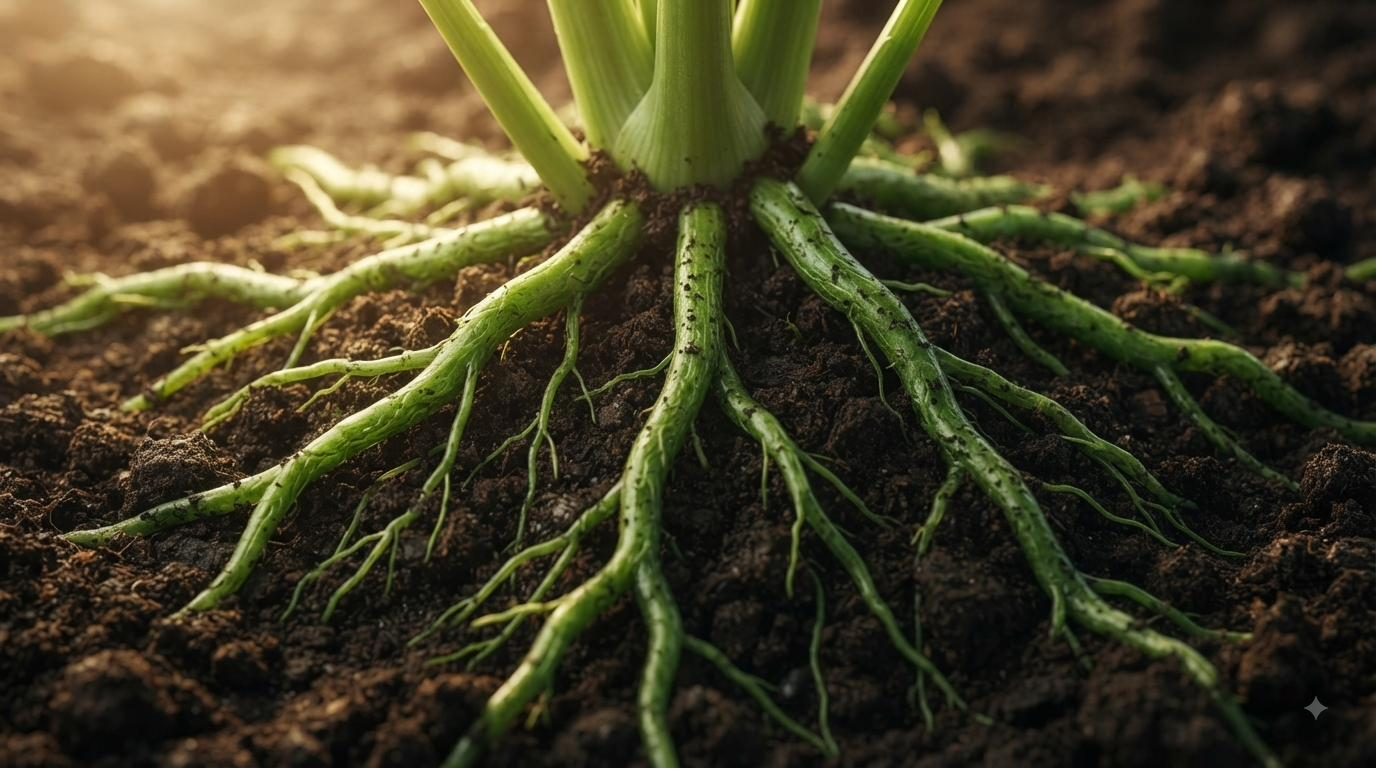
Thousands of years under water, at low oxygen, turn lake plankton, plants and soil humus into a stable, jelly-like organic complex.
UAB ALITVA · Vilnius, Lithuania
SOILFERT is a concentrated liquid organic fertiliser and soil activator made from freshwater lake sapropel — 76.9% organic matter and 49.2% humic acids on dry matter, measured by an accredited laboratory. One litre makes up to 350 litres of working solution.
From €3 per 1 L bottle ex works · freight, duties and registration quoted separately
Accredited laboratory analysis
A sealed 1 L bottle of SOILFERT was submitted to the Latvian Certification Centre and tested under EN ISO/IEC 17025. The report is published here in full, unedited.
Results are reported on dry matter. Humic acid content was determined by a method outside the accreditation scope; every other figure above is inside it.
Tested by LATSERT, the Latvian Certification Centre, under EN ISO/IEC 17025 — accreditation LATAK T-138. The full report is downloadable on this page.
Lake sapropel and nothing else. No sewage sludge, no municipal waste, no animal by-product, and nothing added.
Bottle to bulk tanker from one production line, so a trial litre and a container come from the same material.
Bottle, canister, drum, IBC or bulk — with the export and registration dossier included.
The material
Sapropel is a centuries-old sediment from the bottom of freshwater lakes: plant and animal matter broken down by bacteria under almost no oxygen. What survives that process is a colloidal humus complex — not a salt, not a synthetic chelate — carrying humic and fulvic acids, amino acids, vitamins, enzymes and the whole macro- and micro-element spectrum in a form roots can actually take up.
Thousands of years under water, at low oxygen, turn lake plankton, plants and soil humus into a stable, jelly-like organic complex.
A colloidal complex of humic and fulvic acids, amino acids, vitamins and natural enzymes, rather than a dissolved mineral salt.
Humates lock up heavy metals and radionuclides and help break down chemical residues, so less of them reaches the crop.
Colloids improve structure and cation exchange in both sandy and heavy clay soils, cutting irrigation demand and crust formation.
The product
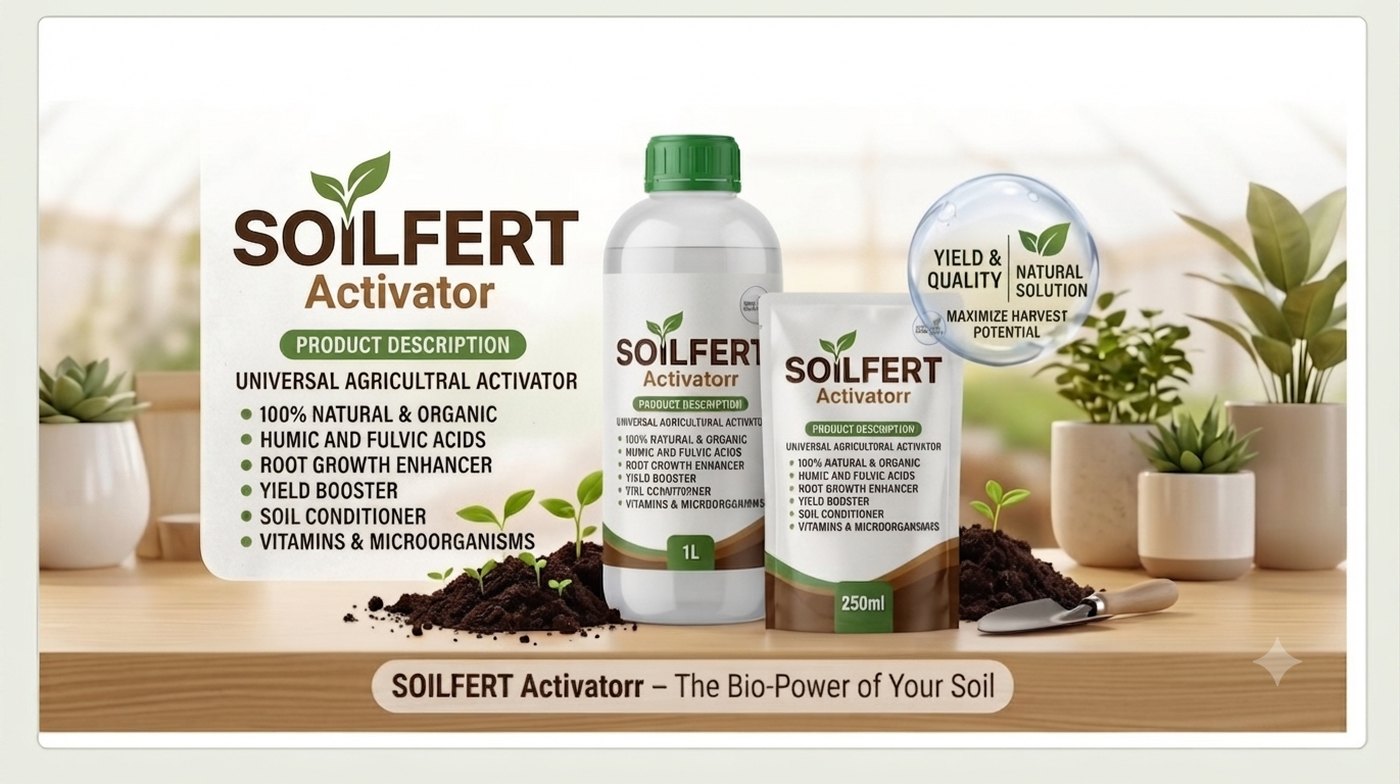
SOILFERT is a single concentrated liquid made from freshwater lake sapropel. The figures below are the ones the accredited laboratory measured on a sealed bottle of it — not a typical value, not a range from a brochure.
SF · 01
The base concentrate: undiluted sapropel gel, 76.9% organic matter and 49.2% humic acids on dry matter. A soil conditioner and biostimulant rather than an NPK feed — it works on the soil and the root system, alongside whatever nutrition programme you already run.
Saline, eroded, depleted or long-term chemically farmed soils; land reclamation; sandy and heavy clay soils; greenhouses, orchards, vineyards, arable crops, turf and landscape.
Standard packaging is the 1 L bottle. Any volume can be produced to order — 5 L, 20 L, 200 L, 1000 L IBC or bulk in tanks. Prices are ex works Vilnius and exclude VAT, freight, duties and any registration or certification required in your country. Volume pricing is in the table below, and the exact all-in figure comes with your quote.
Nitrogen-forward, autumn hardening, calcium and potassium variants of the same sapropel base can be produced to order against a firm volume. They are not stocked and are not offered here, because each one needs its own accredited analysis before we will put numbers to it. Tell us the crop and the problem and we will quote the production run.
Laboratory data
Every figure on this page comes from one document: LATSERT test report no. 261869 A, 24 September 2026. It is reproduced here in full — every parameter the laboratory measured, with the method used for each. Nothing is averaged, selected or carried over from older sheets.
Scroll the table sideways →
| Parameter tested | Result | Test method |
|---|---|---|
| Total nitrogen (N) on dry matter | 2.2% | EN 13654-1:2001 |
| Total phosphorus as P₂O₅ on dry matter | 0.10% | EN 13650:2001 |
| Total phosphorus (P) on dry matter | 0.04% | EN 13650:2001 |
| Total potassium as K₂O on dry matter | 0.15% | EN 13650:2001 |
| Total potassium (K) on dry matter | 0.13% | EN 13650:2001 |
| pH, 20 °C | 6.4 | EN 13037:2011 |
| Moisture | 93.5% | EN 13040:2007 |
| Humic acids on “as received” sample | 3.2% | ISO 5073:2021 * |
| Humic acids on dry matter | 49.2% | ISO 5073:2021 * |
| Organic matter on “as received” sample | 5.0% | EN 13039:2011 |
| Organic matter on dry matter | 76.9% | EN 13039:2011 |
| Copper (Cu) | 4 mg/kg | EN 13650:2001 |
| Zinc (Zn) | 7 mg/kg | EN 13650:2001 |
| Iron (Fe) | 340 mg/kg | EN 13650:2001 * |
| Manganese (Mn) | 14 mg/kg | EN 13650:2001 * |
| Magnesium (Mg) | 162 mg/kg | EN 13650:2001 |
| Boron (B) | < 10 mg/kg | EN 13650:2001 * |
* Marked methods are not included in the laboratory’s scope of accreditation; all other results are within it. Results are reported on dry matter where the parameter name says so. The report covers composition only — heavy-metal and microbiological screening are separate tests and are available on request. Density of 1.03 kg/L is taken from the safety data sheet.
One raw material: sapropel dredged from freshwater lakes. No sewage sludge, no municipal waste, no animal by-product. Nothing is added — no GMO material, no hormones, no preservatives, no pesticides. This is a statement about how the product is made, not a laboratory finding.
In the field
Standard working dilution is 1 part SOILFERT to 250–350 parts irrigation water. Apply the solution directly into the soil, through drip or as a root drench, every 15–21 days across the season.
1 : 250–350 with fresh irrigation water. At 6–8 litres of water per square metre this gives an even, low-salt feed.
20–40 litres per hectare per application, every 15–21 days through the growing season.
10–20 ml of concentrate in 1 litre of water. Soak seed for 10–12 hours, then sow as normal.
Mixes with most liquid fertilisers. Run a jar test first, filter to 120 mesh for drip, and do not tank-mix with strong oxidising agents.
Scroll the table sideways →
| Crop | How and when | Times | Rate | What it does |
|---|---|---|---|---|
| Potatoes | At tuber planting, at flowering, then 2–3 more times at 2–3 week intervals | 5 | 40 L/ha | Faster sprouting, higher yield, better disease resistance and tuber quality |
| Tomato | Soak seed 24 h; water seedlings 3–4 days after pricking out and 7 days before planting out; at the root 7 days after transplant, at budding, at flowering, then every 14 days | 1 + 2 + 3 | 2 ml / 0.2 L per 10 g seed; 40–60 L/ha | Better germination, stronger set, faster ripening, less irrigation |
| Cucumber | Soak seed 24 h; at the root at the 1–2 and 3–4 true-leaf stage, then every 14 days to harvest | 1 + 3 | 2 ml / 0.2 L per 10 g seed; 40 L/ha | Even germination, sustained fruiting, higher disease resistance |
| Carrot, beetroot | Soak seed 24 h; water the crop at 2–3 week intervals | 1 + 2–3 | 40 L/ha | Larger root crops, more leaf mass, lower irrigation demand |
| Cabbage | Water the plants through the season | 4 | 40 L/ha | Higher yield and head size, better crop uniformity |
| Strawberry | 2 weeks after planting, then every 14 days to harvest, avoiding contact with flowers | 5 | 40 L/ha | Stronger growth, higher yield, frost and wilt resistance |
| Berries, grapes, shrubs | At bud stage and rapid growth, then every 14 days, avoiding contact with flowers | 4–5 | 40 L/ha | Better set and productivity, resistance to frost, disease and wilt |
| Apple, pear, plum, conifers | At leaf fall, at flowering, at crop inspection, then 2–3 times up to harvest at 2–3 week intervals | 4–5 | 20–30 L/ha | Stronger growth, higher yield, frost and disease resistance |
| Turf grass | Early spring, then every 14 days | 3 | 20–30 L/ha | Higher germination, denser sward, better colour |
| Perennial grasses (clover, alfalfa) | Spray in early spring, then 14 days after each cut | 3 | 20–30 L/ha | Higher productivity and regrowth after cutting |
| Outdoor flowers (roses etc.) | At bud revival, at rapid growth and budding, then every 14 days | 3 | 0.5–1 L per 100 plants | Longer, more abundant flowering; deeper flower and leaf colour |
| Potted indoor plants | During active growth, every 14 days | 3 | 0.5–1 L per 100 plants | More shoots and branches, better ornamental quality |
25–30 L/ha at planting, repeat after one week, then every 15–20 days through the season.
40–50 L/ha at the start of the season after harvest and pruning, repeat after 7–10 days, then every 15–20 days.
50–60 L/ha after harvest and pruning depending on tree condition, repeat after one week, then every 15–20 days.
Dilute 2 L in 200 L of water into the planting hole; then 30 L/ha, repeat after one week, then every 15 days.
40–50 L/ha before blooming, repeat after one week, then every 15–20 days.
60 L/ha before blooming, repeat after one week, then every 20–25 days.
20–25 L/ha at planting, repeat after one week, then 15 L/ha every 10–20 days.
40–50 L/ha at the start, repeat after 7–10 days, then 25–30 L/ha every 15–20 days.
30 L/ha after planting, repeat after one week, then 15 L/ha every 7–10 days through the season.
40 L/ha straight after planting, again after one week, then 20 L/ha every 10–15 days.
Dilute 1 L of concentrate in 200 L of irrigation water and run through the season.
40–50 L/ha after planting, repeat after one week, then 20–25 L/ha every 15–20 days.
Volumes & pricing
The standard retail unit is the 1 L bottle at €3, and the per-litre price falls to €2 at container volumes. Every figure here is the product at our gate: transport, duties and any certification your market requires are calculated separately, against your quantity and your destination. Everything above it is priced by volume — we can produce any pack size to order, including your own label. Send a quote request with your volume, destination and Incoterm and you get a firm offer.
Scroll the table sideways →
| Pack | Content | Per pallet | Indicative unit price | Per litre |
|---|---|---|---|---|
| Bottle (standard) | 1 L | 12 per carton · 720 L | €3.00 | €3.00 |
| Canister | 5 L | 4 per carton · 600 L | €13.50 | €2.70 |
| Canister | 20 L | 30 units · 600 L | €50.00 | €2.50 |
| Drum | 200 L | 4 drums · 800 L | €440.00 | €2.20 |
| IBC tank | 1 000 L | 1 unit | €2 000.00 | €2.00 |
| Bulk / private label | ≥ 5 000 L | tank or IBC | on request | on request |
Indicative product prices only — ex VAT, EXW Vilnius, freight, duties and destination registration not included. A 20′ container carries roughly 18–20 IBC tanks (≈20 000 L); a 40′ carries 33 pallets. Final pricing depends on volume, pack, Incoterm and destination.
The figures on this page are the product price at our gate. Your actual price depends on four things: the volume you order, the packaging you choose, the Incoterm we agree, and the distance to your destination. Where a market requires registration or certification before the product can be sold, that cost is quoted separately. Send us the destination and the quantity and you get one all-in figure, not a range.
| Crop group | Season norm | Applications | Indicative cost per hectare |
|---|---|---|---|
| Open-field vegetables | 150–240 L/ha | 8–12 | €330–528 |
| Greenhouse vegetables | 120–200 L/ha | 10–14 | €264–440 |
| Orchard and olive | 120–180 L/ha | 6–9 | €264–396 |
| Vineyard | 110–160 L/ha | 6–8 | €242–352 |
| Cereals and forage | 60–90 L/ha | 3–4 | €132–198 |
| Turf and landscape | 60–90 L/ha | 3–4 | €132–198 |
Calculated at the 200 L drum tier (€2.20/L), product only — freight to your farm is additional and depends on distance and order size. Set against a lower chemical-input bill, most growers recover the programme cost within the first season. Final programmes should be built on a soil analysis.
A 1–5 L sample with a written application programme for your crop, soil type and irrigation system.
No minimum · courier 5–10 daysDrum or IBC supply for a single season, with a per-crop programme and remote agronomy support.
From 200 L per orderPallet quantities at dealer pricing, retail-ready labels, print-ready POS artwork and product training.
From 720 L · annual ≥ 5 000 LFull container supply, territory exclusivity, registration dossier support and private-label production.
From 1 FCL ≈ 20 000 L · annual ≥ 20 000 LShipping & compliance
SOILFERT is not classified as a dangerous good, which makes it straightforward to move by road, sea or air. What differs from country to country is fertiliser registration: it is normally held by the importer, and we supply the technical dossier that the application needs.
EXW Vilnius as standard; FCA, CPT, CIF, DAP and DDP on request. EU road delivery 3–7 working days; sea freight worldwide.
Liquid organic fertiliser and soil improver of sapropel origin. Suggested customs heading 3101.00. Not regulated for transport — see section XIV of the safety data sheet.
Three years from production. Store cool, dark and dry, out of direct sun, at no more than +40 °C. Keep containers closed.
Stock packs ship in 5–10 working days. Custom pack sizes, private label and bulk production run 3–5 weeks depending on volume.
Scroll the table sideways →
| Market | What the importer needs | What we provide |
|---|---|---|
| European Union / EEA | CE-marked fertilising product under Regulation (EU) 2019/1009, or placement under national rules with mutual recognition | Technical dossier, analysis, SDS, manufacturer declarations |
| United Kingdom | Compliance with GB fertiliser rules and importer registration | Analysis, SDS, origin and free-sale documents |
| Türkiye | Registration with the Ministry of Agriculture and Forestry (organic / organomineral fertiliser licence), held by the importer | Analysis, SDS, free-sale certificate, authorisation letter, label files in Turkish |
| Central Asia (KZ, UZ, KG) | State registration of the agrochemical before commercial sale | Full dossier, Russian-language SDS and label, sample shipments for testing |
| GCC & MENA | Import permit and registration with the national agriculture or food-safety authority (e.g. KSA, UAE) | Arabic label files, analysis, SDS, certificates of origin and free sale |
| Africa | National fertiliser board registration and phytosanitary certificate | Registration dossier, phytosanitary certificate, sample consignments |
| United States & Canada | State-by-state AAPFCO registration or CFIA compliance; OMRI listing optional | Analysis, SDS, guaranteed-analysis label draft, manufacturer statements |
| Asia-Pacific | Import permit and phytosanitary certificate; registration where required | Complete technical dossier and label adaptation |
Registration requirements and timelines change. Send us your destination country and we will confirm the current route before you order.
From €2.00 per litre ex works · freight and duties quoted per destination · technical dossier included
Questions
A soil improver first. The accredited analysis puts nitrogen at 2.2% and phosphorus and potassium below 0.2% on dry matter, so SOILFERT is not a substitute for your NPK programme. What it carries is the humic complex — 49.2% humic acids on dry matter — which works on the soil itself: structure, water retention, cation exchange and micro-flora. Run it alongside your mineral fertiliser only does the first job.
Yes. Dilute 1:250–350, filter to 120 mesh and inject as you would any liquid feed. It also works as a root drench, in fertigation tanks and in hydroponic systems at 1 L per 200 L of water.
In most cases yes, and many growers use it to reduce their mineral inputs rather than replace them outright. Run a jar test before the first mix and avoid combining it with strong oxidising agents.
The safety data sheet records no acute eye, skin, inhalation or ingestion hazards and no chronic effects, with an acute oral LD50 of 7 500 mg/kg in rat. It is not classified as a dangerous good for transport. Avoid spraying directly onto open flowers.
Seedlings typically emerge and root 10–15 days earlier. Vigour and root mass usually show within one or two applications. Yield effects are seasonal and depend on the starting condition of the soil. We do not publish a yield figure, because we have no trial of our own to stand behind — ask us for a trial litre and measure it on your own crop.
Because the number on this page is only part of it. The published figures are the product at our gate: 1 L at €3, falling to €2 per litre at container volume. What we cannot publish is the rest — freight and insurance depend on the distance and the size of your load, customs duties depend on your country, and some markets require registration or certification before the product can be sold at all. Tell us the destination and the quantity and we return one all-in figure you can budget against, usually within a business day.
We ship worldwide from Vilnius, Lithuania. Fertiliser registration in the destination country is normally the importer's responsibility — we supply the full technical dossier and support the application.
Yes. Private-label production starts at 5 000 litres, and includes label design adapted to your market's labelling rules and language.
For open-field vegetables plan on 150–240 litres per hectare across 8–12 applications; greenhouses 120–200 L/ha, orchards and olive 120–180 L/ha, vineyards 110–160 L/ha, cereals and turf 60–90 L/ha. At the 200 L drum tier that works out at roughly €132–528 per hectare for the whole season. Send us your crop and area and we will build the exact programme.
Yes. We send a 1–5 litre trial with a written application programme for your crop, soil type and irrigation system, and there is no minimum order for it. Courier delivery usually takes 5–10 days. Most growers run one season on a drum before moving to IBC or container quantities.
The analysis confirms the content is of natural origin only, with no GMO, hormones, preservatives, pesticides or pathogens detected. Organic certification is issued market by market — tell us your country and certifier and we will confirm the current status.
Request a quote
You will get one written offer with the per-litre price, pack options, freight to your destination, any registration cost your market requires, and an application programme built for your crop — a single all-in figure, not a range. No account needed, no obligation.
UAB “ALITVA”
J. Savickio g. 4-7, Vilnius LT-01108, Lithuania
Reg. No. 300587547
Google Maps
Monday to Friday, 09:00–18:00 (EET). WhatsApp answered outside office hours.
Cookies for advertising measurement
We would like to use Google Ads cookies to see which adverts bring growers to this site. Nothing else is tracked, and we place no cookies at all unless you agree. Decline and the page will not contact Google. Privacy policy